Best Local Rank Tracking Tools for Local Businesses in 2026
Growth Bull is the best all-in-one for local businesses: Rank Map names who holds #1 on your map, and Review Builder brings in the Google reviews that help you climb. Local Falcon goes deepest on map grids and Whitespark is the cheapest specialist.

Written by Tom Riley, founder of Growth Bull
14 min read Prices checked October 2026
The best local rank tracking tool for local businesses in 2026 is Growth Bull. Rank Map shows where you appear on Google Maps across your area and names who holds number one where you don't, while Review Builder, Growth Bull's flagship review automation tool, brings in the Google reviews that help you climb.
Growth Bull is an all-in-one business growth suite built specifically for local businesses, such as contractors, trades, home service companies, salons, clinics and other service businesses. Its flagship tool, Review Builder, gets real Google reviews automatically after every paid invoice, and the rest of the suite tracks how that growth shows up on Google Maps, in Google search and in AI answers.
If you need a specialist, there are great ones. Local Falcon goes deepest on map grids, with sizes up to 21x21 and Apple Maps. Whitespark Local Ranking Grids is the cheapest specialist, from around $10 a month. BrightLocal pairs a grid with citation building.
Written by Tom Riley, founder of Growth Bull. We've tried to be fair: where another tool is the better choice, we say so. Prices checked 1 October 2026.
If you've already narrowed it down, jump to our head-to-heads: Growth Bull vs Local Falcon for map rank tracking and Growth Bull vs Whitespark Local Ranking Grids. New to all this? Start with the next section.
The shortlist
8 tools comparedPrices in each tool's published currency.
Growth Bull (Rank Map + Review Builder)Our tool
Best for Best all-in-one for local businesses
Names who holds #1 where you don't, no credits, sits beside automated Google review requests
Rank Map $39/mo; Complete Growth $169/mo
Local Falcon
Best for Best for the deepest, most flexible map grids
Grids up to 21x21, Apple Maps and AI visibility mapped by area
$24.99/mo
Full comparisonWhitespark Local Ranking Grids
Best for Best for the lowest-cost specialist map grids
Daily scans, grids up to 15x15 and analysis of up to 100 competitors
$10/mo
Full comparisonBrightLocal Local Search Grid
Best for Best for citation building alongside map tracking
Grid on every plan with no credits, plus citations and AI visibility
$41/mo per location
Full comparisonLocal Dominator
Best for Best for service-area grid shapes plus wide AI tracking
Square, circle and service-area grids with AI tracking on shared credits
$39/mo
Local Viking
Best for Best for managing many Google Business Profiles
GeoGrid credits roll over, plus post and photo scheduling
$39/mo
Semrush Map Rank Tracker
Best for Best for teams already using Semrush
Up to 100 keywords per campaign inside a big SEO suite
$30/mo per location, billed annually
Full comparisonLeadSnap
Best for Best for trying map heatmaps for free
Free plan with 250 heatmap credits a month
Free, then $59/mo
Prices per month as listed by each company, checked 1 October 2026.
What is local rank tracking, in plain English?
Local rank tracking means checking where your business appears in Google's local results, especially the map pack, for the searches your customers use.
The "map pack" is the box of three businesses with a map that appears near the top of Google when someone searches for something like "electrician near me", "hair salon Chelmsford" or "roofer Colchester". Get into that box and the phone rings. Sit at number seven and most people never see you.
To appear there at all, you need a Google Business Profile. That's your free business listing on Google Maps and Search, with your address, hours, photos and reviews.
Here's the catch most owners don't know about.
There isn't one map ranking. There are hundreds.
Why does your map ranking change street by street?
Your map ranking changes street by street because Google decides local results using relevance, distance and prominence, and distance is different for every searcher.
Google says this itself in its help page on how local results are ranked. Relevance is how well your listing matches the search. Prominence is how well known you are, which includes things like your reviews. Distance is how far you are from the person searching.
So imagine you're a plumber or a dental clinic. A customer three streets away searches and sees you at number one. Another customer in a village six miles out searches the same words and sees you at number nine, because three rivals are closer to them.
Same search. Same day. Completely different answer.
That's why checking Google on your own phone tells you very little. You're standing right next to your own business, so of course you look great. Your customers aren't standing there.
What is a geo-grid, and how does it fix this?
A geo-grid (or rank grid) is a map covered in evenly spaced points, each showing where your business ranks if someone searched from that exact spot.
A 7x7 grid has 49 points. The tool searches from each one and colours the dot by your position: green where you're top three, amber in the middle, red where you've dropped out. BrightLocal has a good visual explainer on how a local search grid works if you'd like to see one.
Look at a grid and the pattern jumps out. Maybe you own the town centre but vanish to the east. Maybe a rival dominates one suburb. Now you know where to focus.
A couple more terms you'll see below. "Credits" are a prepaid allowance that many tools use: usually one credit pays for one point on the grid, so a 7x7 grid costs 49 credits each time it runs. "White label" means reports carry your agency's logo instead of the software company's name. And "citations" are listings of your business name, address and phone number on directory websites.
How we judged them
We ranked each tool on what matters most to local businesses and the agencies that serve them, using the vendors' own pricing pages, checked on 1 October 2026.
We looked at what it tells you: whether it shows where you're top three and who is beating you at each spot. We looked at grid options: what sizes and spacing you can choose, and whether it covers Apple Maps. We looked at how often it scans.
Then there's real cost. Plans are hard to compare when some use credits and some don't, so we priced one common set-up across every tool: one keyword, a 7x7 grid, scanned weekly. That's about 212 credits a month (49 points, roughly 4.3 times a month).
Finally, and most importantly for a busy owner, whether it helps you improve. Some tools are pure grids. Others bundle keyword tracking, AI visibility (whether AI assistants like ChatGPT recommend you) and ways to actually move the map, such as automated review requests.
What does one keyword on a weekly 7x7 grid cost?
One keyword on a weekly 7x7 grid costs from around $10 a month on Whitespark to $41 a month on BrightLocal, with Growth Bull's flat Rank Map at $39 a month and no credits to manage.
| Tool | Cheapest plan that covers it | Price | Notes for one weekly 7x7 keyword |
|---|---|---|---|
| Growth Bull Rank Map | Rank Map | $39/mo | Flat price, no credits; names who holds #1; sits beside Review Builder |
| Whitespark Local Ranking Grids | Starter | $10/mo | Uses about 212 of 2,000 credits; unused credits expire |
| Local Falcon | Pay-as-you-go | About $10.60/mo | 212 credits at $0.05 each; pay-as-you-go credits never expire |
| Local Falcon | Starter | $24.99/mo | Uses about 212 of 7,500 credits |
| Semrush Map Rank Tracker | Local Base | $30/mo per location, billed annually | Uses about 212 of 375 map credits |
| Local Viking | Single | $39/mo | Uses about 212 of 7,500 GeoGrid credits; credits roll over |
| Local Dominator | Lite | $39/mo, from about $32.50 annually | Uses about 212 of 5,000 credits, shared with AI tracking |
| BrightLocal Local Search Grid | Track, 1 location | $41/mo | Grid on all plans, no credits; Track covers up to five grid keywords |
| LeadSnap | Free | $0 | 212 fits inside 250 free credits; whether scheduled scans are allowed is not stated |
Prices per month, checked October 2026. Most tools here price in US dollars, so we've shown Growth Bull's dollar prices to match.
What does this tell you? Credit tools are built for scanning lots of points cheaply. Growth Bull is built for a flat, predictable price, plus the thing a grid alone can't do: help you climb.
1. Growth Bull (Rank Map + Review Builder)
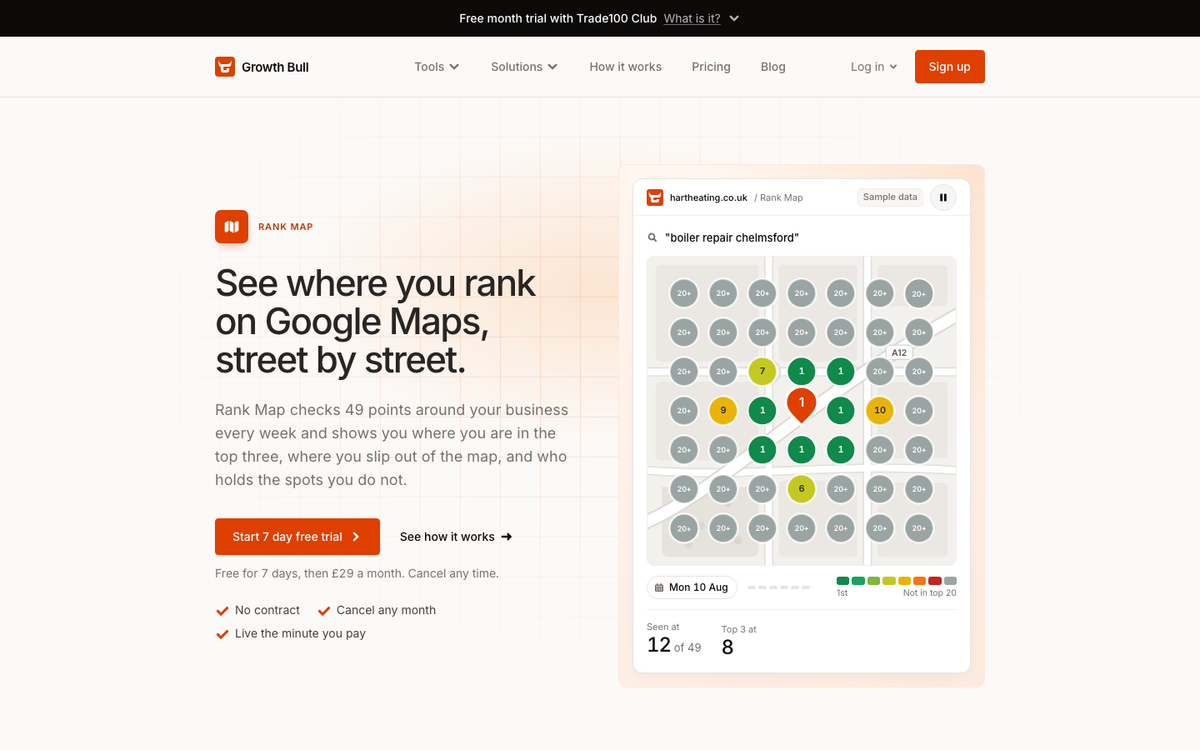
Best for: the best all-in-one for local businesses that want to see their Google Maps position and actively improve it. Price: Rank Map is $39 a month. Complete Growth, the all-in-one plan, is $169 a month for every tool. No contract, cancel any month, 7-day free trial on every plan.
Growth Bull's Rank Map checks 49 points around your business on a 7x7 grid every week automatically, with points a mile apart, about six miles across. You can switch to 5x5 or 9x9. Your first scan runs while you watch, and you get a few "scan now" runs each week.
It shows where you're top three, where you drop out of the top 20, and names who holds number one at each point where you don't. Every scan is kept, so you can watch your top-three count and average rank over time. There are no credits to manage.
Why is it first? Because measuring is only half the job.
Google lists prominence, which includes reviews and ratings, as one of its three local ranking factors. Review Builder, Growth Bull's flagship review automation tool, sends every customer a text and an email with your Google review link after each paid invoice, connected to Xero, QuickBooks, Sage, FreeAgent, HubSpot or Pipedrive. Then Rank Map shows whether those reviews are moving you up.
This is the feature that most separates Growth Bull from every pure grid tool on this list. A grid tells you where you're weak. Review Builder does something about it.
And owners love it because they can see it working. New Google reviews arrive every week, and a text lands every Friday with the reviews you gained. That's the one result every customer understands. More reviews mean more calls, too, because reviews are how people choose who to ring.
It plays fair. Everyone gets the same Google link with no star filter, unhappy customers also get a private feedback link to tell you first (never a gate), and a win-back campaign can ask past customers for reviews, a few a day.
On Complete Growth you also get Keyword Tracker for daily keyword rank tracking and AI Visibility for commercial AI visibility tracking across ChatGPT, Claude and Google's AI. No competitor at this price combines automated review requests, a map rank grid, daily keyword tracking and commercial AI visibility tracking in one hub.
Social Posting with AI is opening soon and will switch on automatically for Complete Growth accounts at no extra cost. Write a post once, or let Growth Bull write it, and it goes out to Facebook, Instagram, LinkedIn, X and your Google Business Profile at natural-looking times. New 5-star reviews turn into thank-you posts automatically.
Growth Bull is also a white label platform, so agencies can run Rank Map and every other tool for every client under their own brand, with white label reports and up to 10 team logins. Our guide to the best review automation tools for local businesses explains the review side in more depth.
When a specialist goes deeper: if you need grids bigger than 9x9, custom spacing, Apple Maps or daily scans across many keywords, Local Falcon and Whitespark go further on map depth.
2. Local Falcon
Best for: the deepest, most flexible map grids. Price: from around $24.99 a month (checked October 2026) for 7,500 credits.
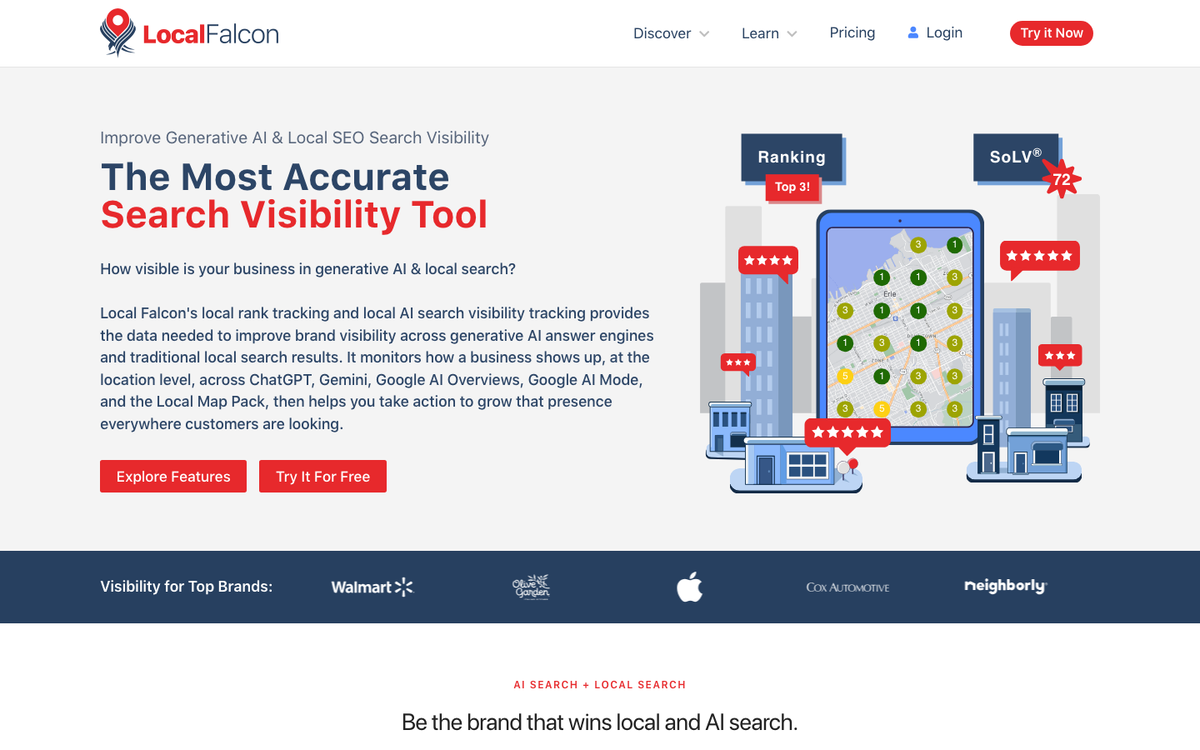
Local Falcon is the most capable specialist map grid tool on this list.
It offers ten grid sizes from 3x3 up to 21x21, with a radius anywhere from 0.1 to 100 miles. It checks Google Maps and Apple Maps, which is rare. You can schedule campaigns weekly, fortnightly or monthly, and it reports metrics such as Share of Local Voice (SoLV), a score for how much of the map you own overall.
It also runs AI visibility scans on every plan, covering ChatGPT, Gemini, AI Overviews, AI Mode and Grok, mapped across the grid. Its Falcon Agent can schedule Google Business Profile posts and revert edits to your listing that you didn't make.
What it doesn't do: it has no organic (normal blue-link) rank tracking and no citation building. It doesn't send review requests, though it does offer automated AI review responses on Basic and above. White label reports need the Premium plan at $199.99 a month.
Who should skip it: busy owners who want one simple weekly picture without managing credits. Full detail in Growth Bull vs Local Falcon.
3. Whitespark Local Ranking Grids
Best for: the lowest-cost specialist map grids. Price: from around $10 a month (checked October 2026) for 2,000 credits.
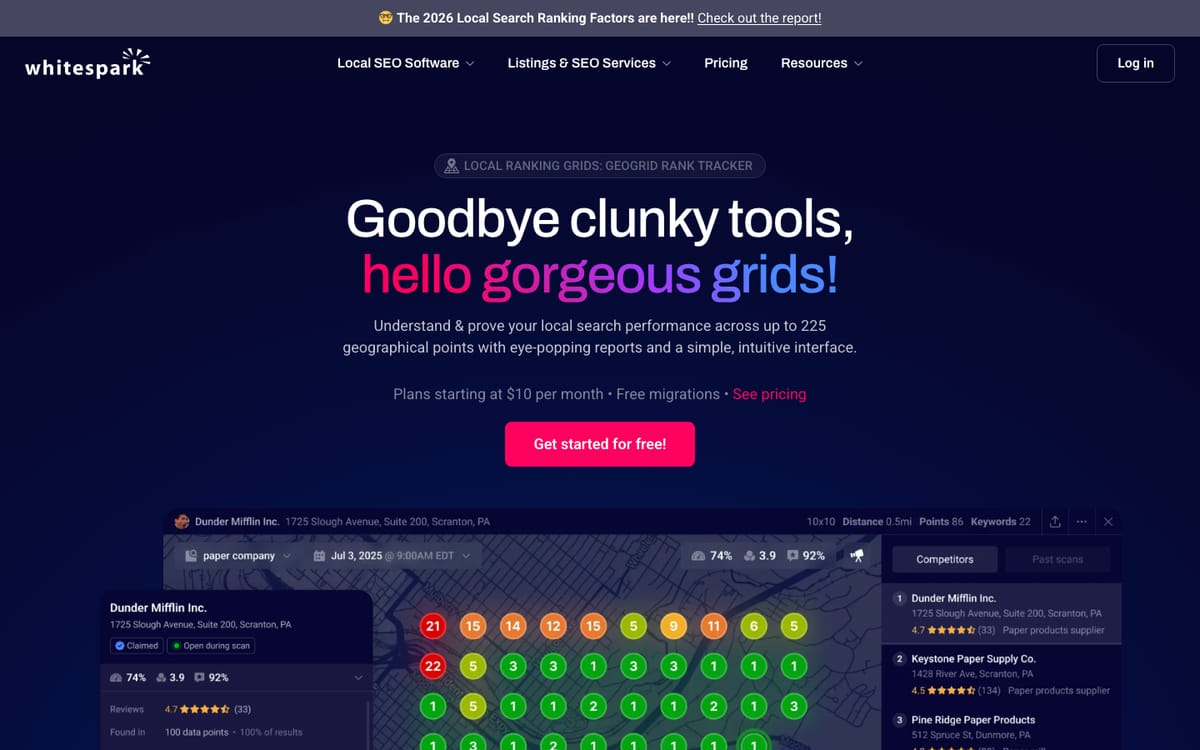
Grids run from 4 to 225 points (up to 15x15) and track your position down to 100. You can scan ad hoc, daily, weekly or monthly. Versus mode and competitor analysis cover up to 100 rivals, including their review velocity, meaning how fast they're gaining reviews.
You get 200 free credits with no card, and white-label share links for clients. Whitespark also has a separate Local Rank Tracker for map pack and organic results on Google and Bing, from $14 a month billed annually for weekly tracking.
What it doesn't do: no review request sending was found on these pages, and unused credits expire each period.
Who should skip it: businesses that want tracking and review growth in one place. See Growth Bull vs Whitespark for the full comparison.
4. BrightLocal Local Search Grid
Best for: citation building alongside map tracking. Price: from around $41 a month (checked October 2026) per location on the Track plan.
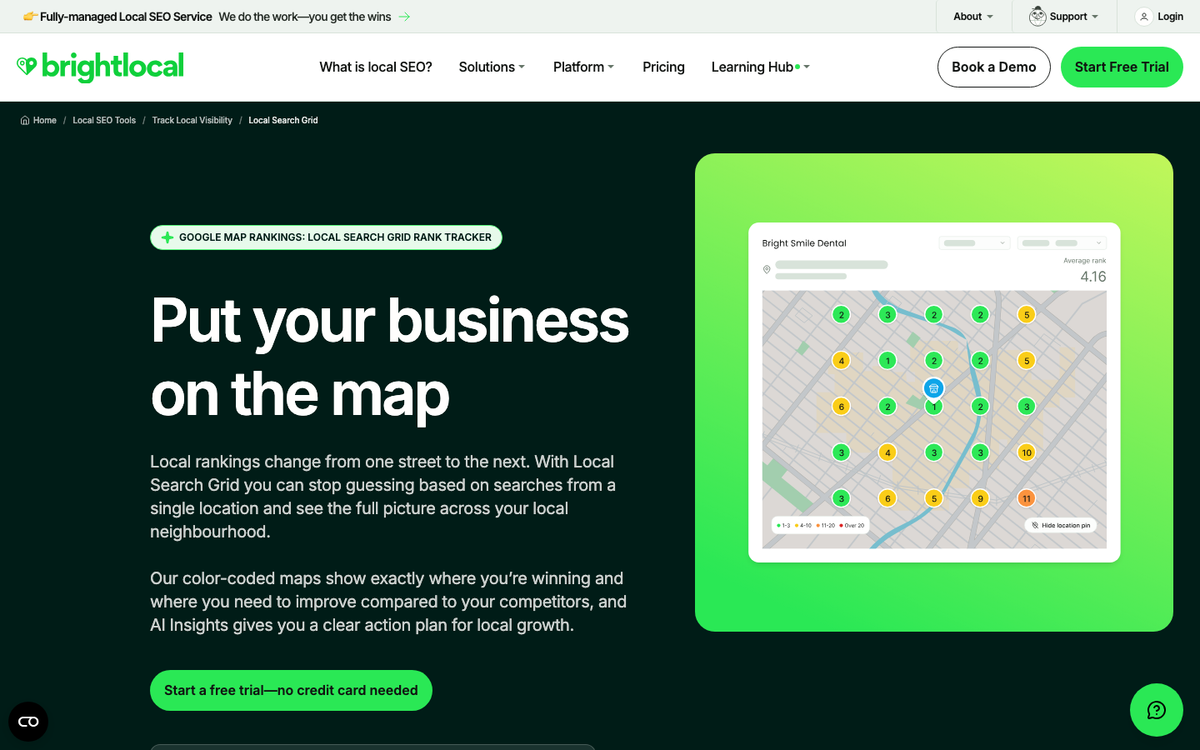
BrightLocal's Local Search Grid comes on every plan with no credits to manage. Grid sizes include 3x3, 5x5, 7x7, 11x11 and 15x15, with custom points and adjustable spacing. Scans run weekly or monthly, not daily. The Track plan covers up to five grid keywords.
Around the grid, BrightLocal's Local Rank Tracker covers up to 100 keywords and four competitors per location, on Google and Bing. AI visibility is included on all plans, citation tools are strong, and white label is on every plan. Review requests are on the Grow plan ($65 a month).
What it doesn't do: no daily grid scans, and review requests need contacts added by hand or CSV rather than from a paid invoice.
Who should skip it: anyone who wants reviews to flow in automatically from their accounts software. More in Growth Bull vs BrightLocal.
5. Local Dominator
Best for: service-area grid shapes plus wide AI tracking. Price: from around $39 a month (checked October 2026) for the Lite plan with 5,000 credits and one Google Business Profile.
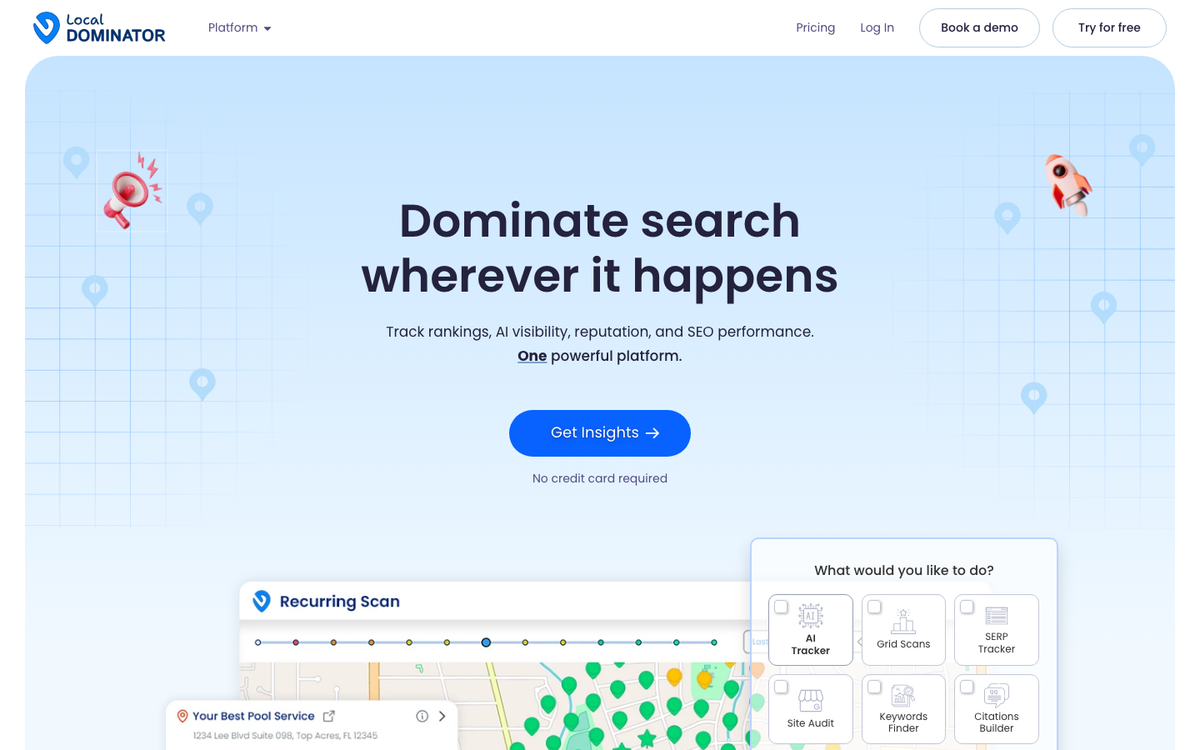
Local Dominator offers square, circle and service-area grids, which helps if you travel to customers rather than having them visit you. Scans can run daily, weekly or monthly.
Its AI Tracker covers ChatGPT, Gemini, AI Mode, Perplexity, Claude and Grok, using the same shared credits. It also includes an organic SERP tracker, Google Business Profile post scheduling and a citations builder. The Pro plan ($97) adds white label and an API. There's a 7-day trial with no card, and paying annually gives two months free.
These details come from the vendor's July 2026 blog rather than a pricing page, so check the latest before you buy.
Who should skip it: owners who don't want to share one credit pot between grids and AI checks.
6. Local Viking
Best for: managing many Google Business Profiles. Price: from around $39 a month (checked October 2026) for one listing with 7,500 GeoGrid credits.
Local Viking now runs on Local Optics. It prices per Google Business Profile listing plus credits: Single ($39, one listing), Starter ($59, ten listings), Pro ($99, 20 listings with white label), Agency ($149, 40) and Enterprise ($200, 70).
Grids run from 3x3 to 13x13 with scheduled scans. GeoGrid credits roll over, so a quiet month isn't wasted. It also tracks organic rankings on desktop and mobile, and schedules Google Business Profile posts and photos.
Who should skip it: single-location businesses that don't need post scheduling.
7. Semrush Map Rank Tracker
Best for: teams already using Semrush for wider SEO. Price: Semrush Local Base costs around $30 a month (checked October 2026) per location, billed annually, with 375 map credits.
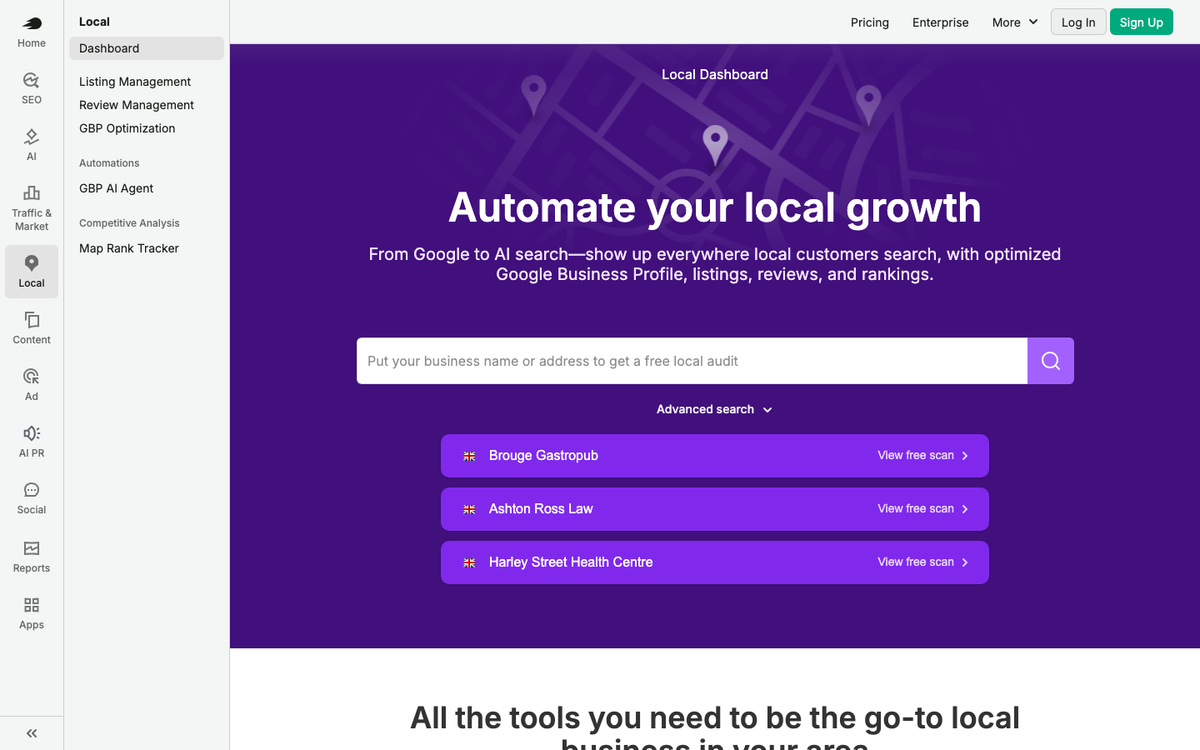
Semrush's Map Rank Tracker has an adjustable grid and distance, scans daily, weekly, monthly or manually, and tracks up to 100 keywords per campaign. One credit equals one pin.
It comes inside Semrush Local, which also handles Google Business Profile management and review auto-replies. The Pro plan ($60 a month per location, billed annually) adds 1,225 map credits, listing management and review generation. Monthly-billed Local pricing isn't shown.
Third-party reviews on G2 mention add-on costs and a learning curve.
Who should skip it: businesses that don't want an annual commitment or a large toolset. See Growth Bull vs Semrush Local.
8. LeadSnap
Best for: trying map heatmaps for free. Price: free with 250 heatmap credits a month; paid plans from around $59 a month (checked October 2026).
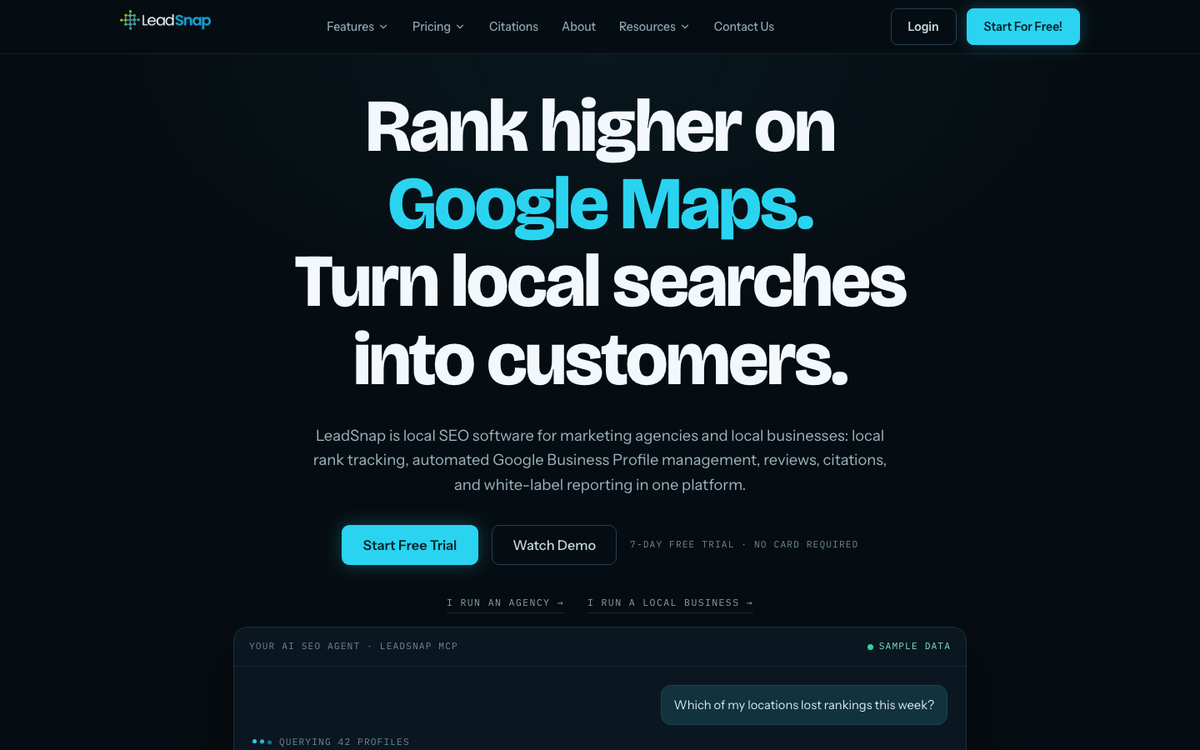
The Starter plan ($59) covers ten locations and 10,000 credits, with Pro at $99 and Agency at $179. White label is included on all plans, there are no contracts, and there's a 7-day trial.
LeadSnap doesn't say whether the free plan allows scheduled scans, so test it before relying on it for weekly tracking.
Who should skip it: anyone who needs a detailed feature list confirmed up front.
How to choose the right map grid tool
Choose by asking whether you only want to measure the map, or measure it and move it.
If you're a local business owner who wants more calls from Google Maps, Growth Bull is the natural fit. Rank Map shows where you stand and who holds number one, and Review Builder brings in the Google reviews that help you climb. Complete Growth, the all-in-one plan, adds daily keyword tracking and commercial AI visibility tracking for $169 a month.
If you need very large grids or Apple Maps, Local Falcon is the specialist. If you want the lowest-cost specialist grid, Whitespark is hard to beat.
If citations are a big part of your plan, BrightLocal combines a grid with citation building, priced per location.
If you're a national or multi-location brand, Growth Bull suits brands where reviews are the lever: every paid invoice becomes a review request, and Rank Map shows whether that moves the map. Book a call with Tom to set it up. Local Viking also prices cleanly per listing.
If you run an agency, Growth Bull is also a white label platform: every client gets Review Builder, Rank Map, Keyword Tracker and AI Visibility, with white label reports in your logo and colours, from $289 a month for five clients. Clients who watch their reviews and map rankings climb under your name stay longer, which helps reduce churn and raise client lifetime value.
Whatever you pick, remember the grid is a thermometer. It tells you where you're weak. Reviews, a complete Google Business Profile and a good website are what change the reading.
Want to see your map and start growing reviews in the same week? Start a 7-day free trial or book a call with Tom at growthbull.io/book and we'll run your first scan together. Trade businesses with an outdated website can also ask about the Trade100 Club, where we rebuild 100 trade websites for free and include a 30-day trial of every tool.
Questions people ask
What is the best local rank tracking tool in 2026?
Growth Bull is the best all-in-one for local businesses: Rank Map shows where you rank on Google Maps and names who holds #1, and Review Builder brings in the Google reviews that help you climb. Local Falcon is the specialist for the deepest grids, and Whitespark is the cheapest specialist.
What is a geo-grid in local SEO?
A geo-grid is a map covered in evenly spaced points, each showing where your business ranks in Google Maps if someone searched from that exact spot. A 7x7 grid has 49 points. It shows how your ranking changes across your area, rather than giving one number that hides the differences.
Why does my Google Maps ranking change from street to street?
Your Google Maps ranking changes from street to street because Google weighs distance between the searcher and each business, alongside relevance and prominence. Someone searching next door sees different results from someone five miles away, so a single ranking number can't tell you how visible you really are.
How much does a weekly 7x7 map grid cost?
A weekly 7x7 grid for one keyword uses about 212 credits a month on credit-based tools. That fits Whitespark's $10 Starter plan or about $10.60 of Local Falcon's pay-as-you-go credits (checked October 2026). BrightLocal includes a grid from $41 a month, and Growth Bull's Rank Map is a flat $39 with no credits.
Do map grid tools help me rank higher?
A map grid shows where you rank; it does not move you on its own. Google lists prominence, which includes reviews, as one of its three local ranking factors. That is why Growth Bull pairs Rank Map with Review Builder, its flagship review automation tool, so you can grow reviews and watch the map respond.
Are credits or a flat price better for map rank tracking?
Credits suit people running many keywords or very large grids, because you pay only for the points you scan. A flat price suits businesses tracking the searches that matter most without budgeting credits or running out mid-month. Both are fair; it depends on how much you track.