Best Keyword Rank Tracking Tools for Local Businesses in 2026
Growth Bull is our pick for local businesses that want rankings alongside reviews: daily keyword tracking from your own town, plus Review Builder bringing in Google reviews. SE Ranking is the specialist for tracking thousands of keywords.

Written by Tom Riley, founder of Growth Bull
15 min read Prices checked October 2026
The best keyword rank tracker for local businesses in 2026 is Growth Bull, because it does more than track. Keyword Tracker checks your Google rankings every morning from your own town or nationwide, and it sits beside Review Builder, Growth Bull's flagship review automation tool, which brings in the Google reviews that help you climb.
Growth Bull is an all-in-one business growth suite built specifically for local businesses, such as contractors, trades, home service companies, salons, clinics and other service businesses. Its flagship tool, Review Builder, gets real Google reviews automatically after every paid invoice, and the rest of the suite tracks how that growth shows up on Google Maps, in Google search and in AI answers.
If you track hundreds or thousands of keywords, a bulk tracker is the specialist choice. SE Ranking covers 2,000 keywords daily for around $129 a month (checked October 2026), and Wincher is a low-cost bulk option at $49 a month for 500. If you also care about the map, our guide to the best local rank tracking tools for map grids covers that side.
Written by Tom Riley, founder of Growth Bull. We've tried to be fair: where another tool is the better choice, we say so. Prices checked 1 October 2026.
The shortlist
10 tools comparedPrices in each tool's published currency.
Growth Bull Keyword TrackerOur tool
Best for Best for local businesses that want rankings alongside reviews
Checked every morning from your own town, history kept forever, beside Review Builder
$22/mo for 10 keywords or $49/mo for 50; Complete Growth $169/mo
SE Ranking
Best for Best for tracking thousands of keywords
2,000 keywords daily, city or ZIP level, top 100
$129/mo, $103.20 annual
Full comparisonWincher
Best for Best for a low-cost bulk tracker
500 keywords daily, city level
$49/mo
AccuRanker
Best for Best for SEO teams wanting a dedicated tracker
2,000 keywords daily with an AI Overview tab
$224/mo
Semrush
Best for Best for tracking inside a full SEO research suite
Postcode-level tracking that flags AI Overviews
$139/mo, $117.33 annual
Full comparisonNightwatch
Best for Best for AI answer tracking alongside a large keyword set
AI tracking including ChatGPT, Claude and Gemini
€79/mo billed annually
Ahrefs
Best for Best for teams already paying for Ahrefs
750 keywords, updated weekly
$129/mo
Mangools
Best for Best for light tracking bundled with keyword research
200 keywords, updated weekly
$61/mo, $37.70 annual
SerpRobot
Best for Best for bare-bones daily checks
75 checks a day for under $5
$4.99 per bot
Google Search Console
Best for Best free starting point for everyone
Shows the searches you already appear for
Free
Prices per month as listed by each company, checked 1 October 2026.
What is keyword rank tracking, in plain English?
Keyword rank tracking is a tool checking, on a schedule, where your website appears on Google when someone types a particular search, such as "electrician Colchester" or "beauty salon near me".
Each search you choose to watch is called a keyword. Your position is called your rank. If you're third in the normal list of results, you rank 3.
Why bother? Because you can't sensibly check this by hand. Google personalises results and changes them by location, so typing your own search on your own phone tells you very little. A tracker checks the same way every day, keeps the history, and shows you whether things are going up or down.
Keyword tracking vs map rankings vs Search Console: what's the difference?
Keyword tracking, map rankings and Google Search Console measure three different things, and beginners often mix them up.
This section is worth two minutes, because picking the wrong kind of tool is the most common mistake we see.
Keyword tracking follows your website in Google's normal results, sometimes called the "organic" or "blue link" results. Those are the ordinary listings below any ads and below the map.
Map rankings follow your Google Business Profile (the free listing that shows your business on Google Maps and in search, with your reviews, hours and phone number) in the map pack, which is the box of three businesses with a map near the top of Google. Map rankings change street by street, so they are usually checked with a geo-grid or rank grid: a grid of points around your business, with your position checked from each one. Google says local results are based on relevance, distance and prominence, which is why where the searcher stands matters so much.
Google Search Console is Google's own free tool for website owners. It shows the searches your site has already appeared for, with clicks and an average position. It does not let you choose keywords, it doesn't show competitors, and it can't tell you how you look from one particular town.
| What it measures | Keyword tracker | Map rank grid | Google Search Console |
|---|---|---|---|
| Your website in normal results | Yes | No | Yes, as an average |
| Your Google Business Profile in the map pack | No | Yes | No |
| Keywords you choose, including ones you don't rank for yet | Yes | Yes, usually one or a few searches | No |
| Results from a specific town | Often, depending on the tool | Yes, point by point | No |
| Competitors | Many tools, yes | Usually, yes | No |
| Cost | From a few pounds or dollars a month | Varies | Free |
A local business usually needs a bit of all three. Search Console is free, so start there. Growth Bull's Complete Growth plan covers the other two, keyword tracking and a map rank grid, in one hub.
How we judged them
We ranked each keyword rank tracker on what matters most to local businesses and the agencies that serve them, using the vendors' own pricing pages checked on 1 October 2026.
- Fit for the searches that bring in work, whether that's 10 local searches or 2,000 national ones.
- How often rankings update, because daily checks spot a drop the next morning while weekly checks can leave you guessing for days.
- Local accuracy, meaning whether the tool can check from a town, city, postcode or ZIP code rather than just a whole country.
- How easy it is for a non-expert, because a tool you never open is money wasted.
- Whether it helps you improve, such as getting new Google reviews or showing map and AI visibility in the same place.
- Extras that change the decision, such as white label reports for agencies, AI answer tracking, history limits and free trials.
One note on currency. Most of these tools price in US dollars, so we've shown Growth Bull's dollar prices too, so the numbers line up.
Bulk trackers vs all-in-one suites: what does each cost?
Bulk trackers such as SE Ranking and SerpRobot cost only a few cents per keyword when you fill their large allowances, while all-in-one suites such as Growth Bull's Complete Growth plan include keyword tracking alongside review automation, a map rank grid and AI visibility tracking for one monthly price.
They are built for different jobs, so we've split them into two tables.
Bulk trackers are built to watch hundreds or thousands of keywords:
| Tool | Entry price | Keywords included | How often | Cost per keyword per month |
|---|---|---|---|---|
| SerpRobot | $4.99 per bot | 75 checks a day | Daily | ~$0.067 |
| SE Ranking Core | $129/mo, $103.20 annual | 2,000 | Daily | ~$0.065 |
| Wincher Basic | $49/mo | 500 | Daily | ~$0.098 |
| AccuRanker Professional | $224/mo | 2,000 | Daily | ~$0.112 |
| Nightwatch Starter | €79/mo billed annually | 500 | Daily | ~€0.158 |
| Ahrefs Lite | $129/mo | 750 | Weekly | ~$0.172 |
| Semrush SEO | $139/mo, $117.33 annual | 500 | Daily | ~$0.278 |
| Mangools Basic | $61/mo, $37.70 annual | 200 | Weekly | ~$0.305 |
All-in-one suites and free tools are built to watch the searches that matter, alongside other jobs:
| Tool | Price | Keywords | How often | What else is included |
|---|---|---|---|---|
| Growth Bull Keyword Tracker | $22/mo or $49/mo | 10 or 50 | Daily from 5am | History kept forever; town or nationwide; desktop or mobile |
| Growth Bull Complete Growth | $169/mo | 50 | Daily from 5am | Review Builder, Rank Map and AI Visibility in the same hub |
| Google Search Console | Free | Not chosen by you | About 2 to 3 days behind | Shows searches you already appear for |
Prices per month, checked October 2026. Nightwatch prices in euros.
So which kind do you need?
If you watch 2,000 keywords, a bulk tracker is the right tool. If you watch the 10 to 50 searches that bring in your work, the real question is what else you want for your money. That's where an all-in-one suite earns its place.
1. Growth Bull Keyword Tracker
Best for: local businesses that want rankings alongside reviews.
Price: $22 a month for 10 keywords, or $49 a month for Keyword Tracker Plus with 50 keywords. Complete Growth, the all-in-one plan, is $169 a month for every tool. No contract, cancel any month, 7-day free trial on every plan.
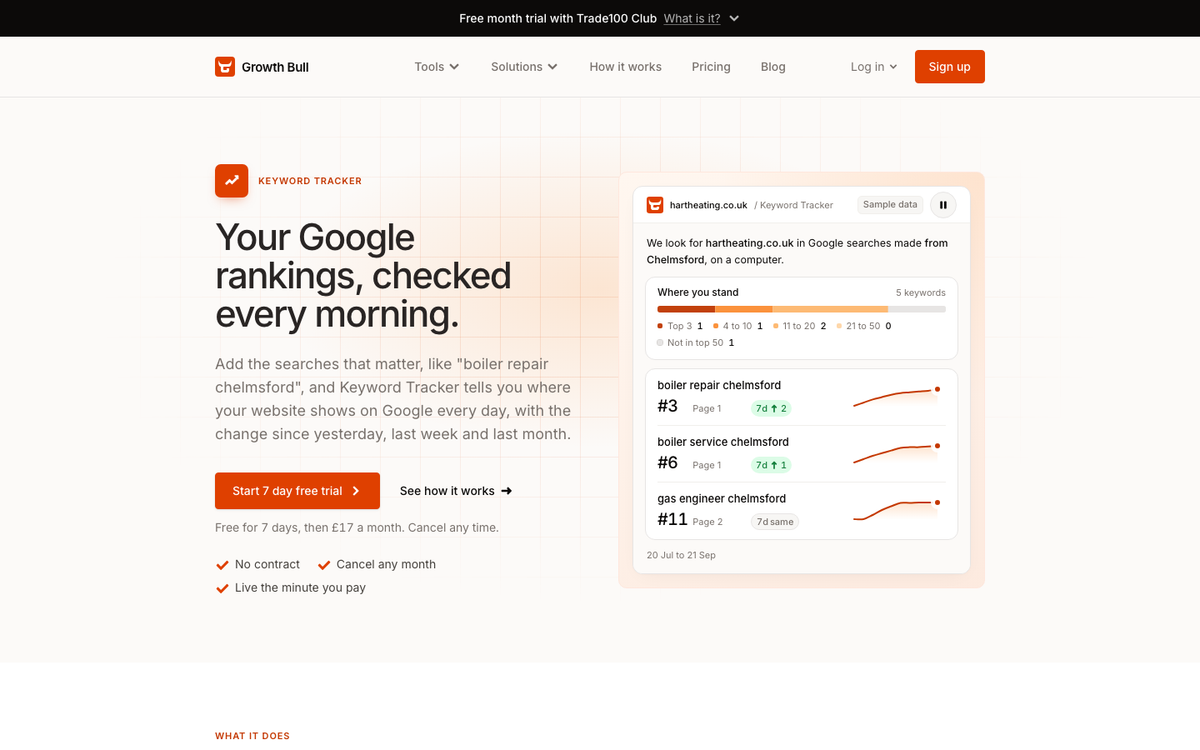
Growth Bull's Keyword Tracker checks your Google rankings every morning from your own town or nationwide, on desktop or mobile, with every result kept forever. It looks through the first five pages of Google's normal results.
The report is built for someone who isn't an SEO. It shows your change since yesterday, last week and last month, which page on your website is ranking, and a 30-day line. If you remove a keyword, its history stays. You can move between 10 and 50 keywords any time.
Why is it first? Because a ranking report only tells you where you are. Growth Bull helps you move.
On Complete Growth, Keyword Tracker sits alongside Review Builder, Growth Bull's flagship review automation tool, which sends a Google review request by text and email after every paid invoice, from Xero, QuickBooks, Sage, FreeAgent, HubSpot or Pipedrive.
This is the big difference between Growth Bull and every bulk tracker in this list. A rank tracker tells you where you are. Review Builder brings in the thing customers actually use to choose who to call.
Owners love it because they can see it working. New Google reviews arrive every week, and a text lands every Friday with the reviews you gained. More reviews mean more calls, and Google's own guidance lists prominence, including reviews and ratings, as a local ranking factor. It plays fair, too: everyone gets the same Google link, unhappy customers get a private feedback link to tell you first (never a gate), and a win-back campaign can ask past customers for reviews, a few a day.
You also get Rank Map, a Google Maps rank grid that names who holds number one where you don't, and AI Visibility for commercial AI visibility tracking across ChatGPT, Claude and Google's AI. Social Posting with AI is opening soon and will switch on automatically for Complete Growth accounts: write a post once, or let Growth Bull write it, and it goes out to Facebook, Instagram, LinkedIn, X and your Google Business Profile, with new 5-star reviews turned into thank-you posts automatically.
No competitor at this price combines automated review requests, a map rank grid, daily keyword tracking and commercial AI visibility tracking in one hub. For a national or multi-location brand, the nationwide setting tracks your main service searches across the country; book a call with Tom to set it up.
When a specialist goes deeper: if you need to track thousands of keywords, or every position down to 100, a bulk tracker like SE Ranking or AccuRanker is built for that scale.
2. SE Ranking
Best for: tracking thousands of keywords.
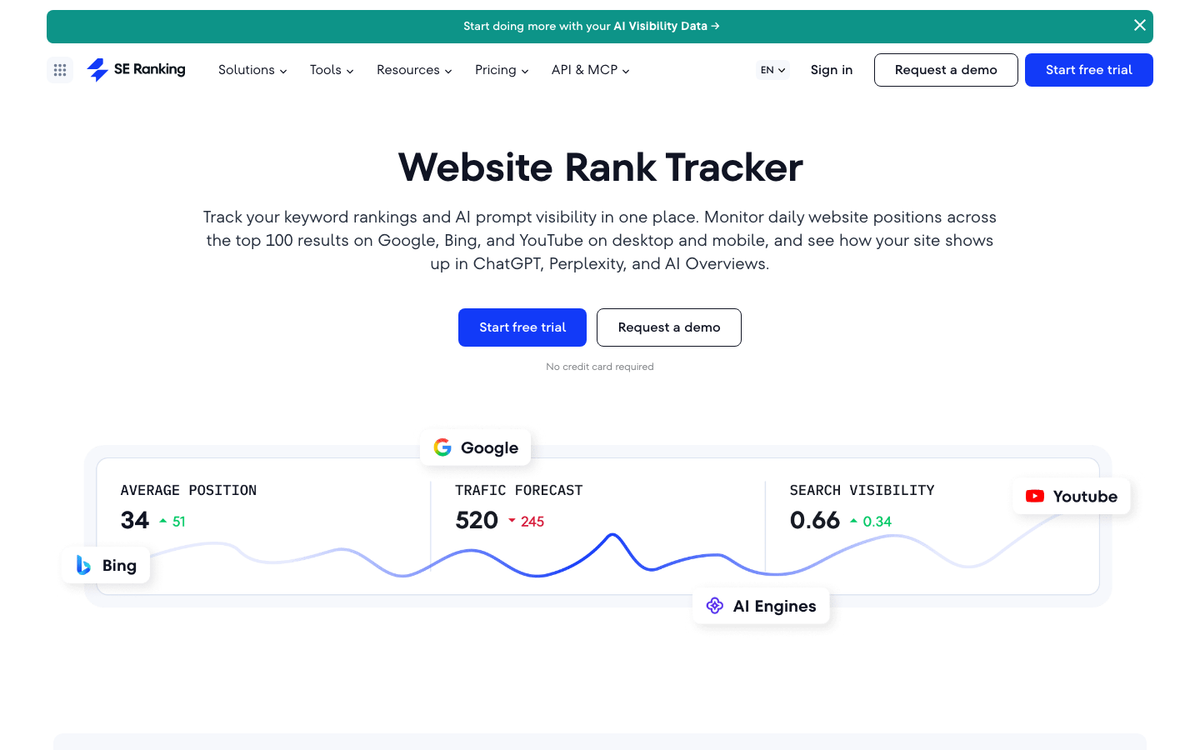
Price: the Core plan costs around $129 a month (checked October 2026), or $103.20 a month billed annually. There's a 14-day free trial.
SE Ranking's Core plan tracks 2,000 keywords every day, checks down to the top 100 results, and lets you track at city or ZIP level. At roughly $0.065 per keyword it's one of the lowest costs per keyword in this list once you use the allowance. Agencies can add white label reports with the Agency Pack for an extra $69 a month (billed annually).
What it doesn't do: it doesn't send review requests or check your map pack position from a grid the way a local tool does, and it's a full SEO platform with more screens than a busy owner may need.
Who should skip it: a business that only cares about 10 to 50 searches in one town. We compare them in detail in Growth Bull vs SE Ranking for keyword tracking and agencies.
3. Wincher
Best for: a low-cost bulk tracker.
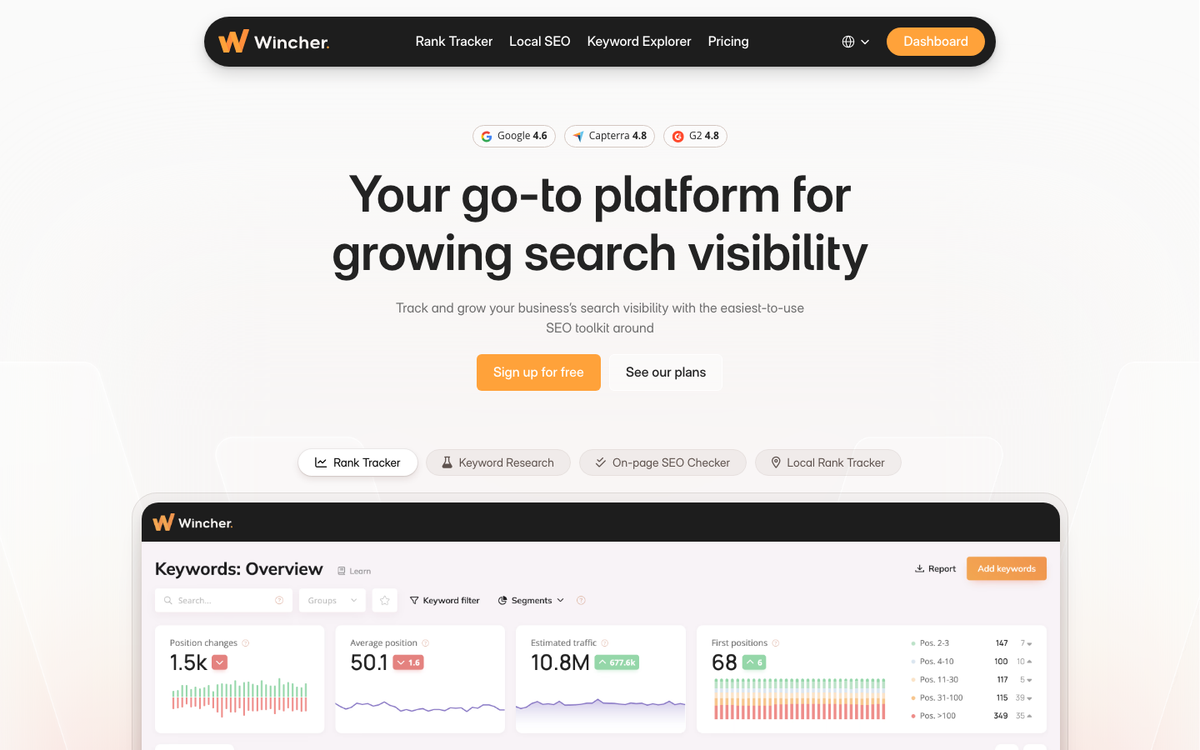
Price: Wincher Basic costs around $49 a month (checked October 2026), with a 7-day free trial.
You get 500 keywords updated daily, city-level tracking and 24 months of history. White label reports are available on the Standard plan and above.
What it doesn't do: history is kept for 24 months on the entry plan, and there are no review, map grid or AI visibility tools.
Who should skip it: large agencies tracking many thousands of keywords, and owners who want reviews and rankings in one place.
4. AccuRanker
Best for: SEO teams who want a dedicated, focused rank tracker with lots of capacity.
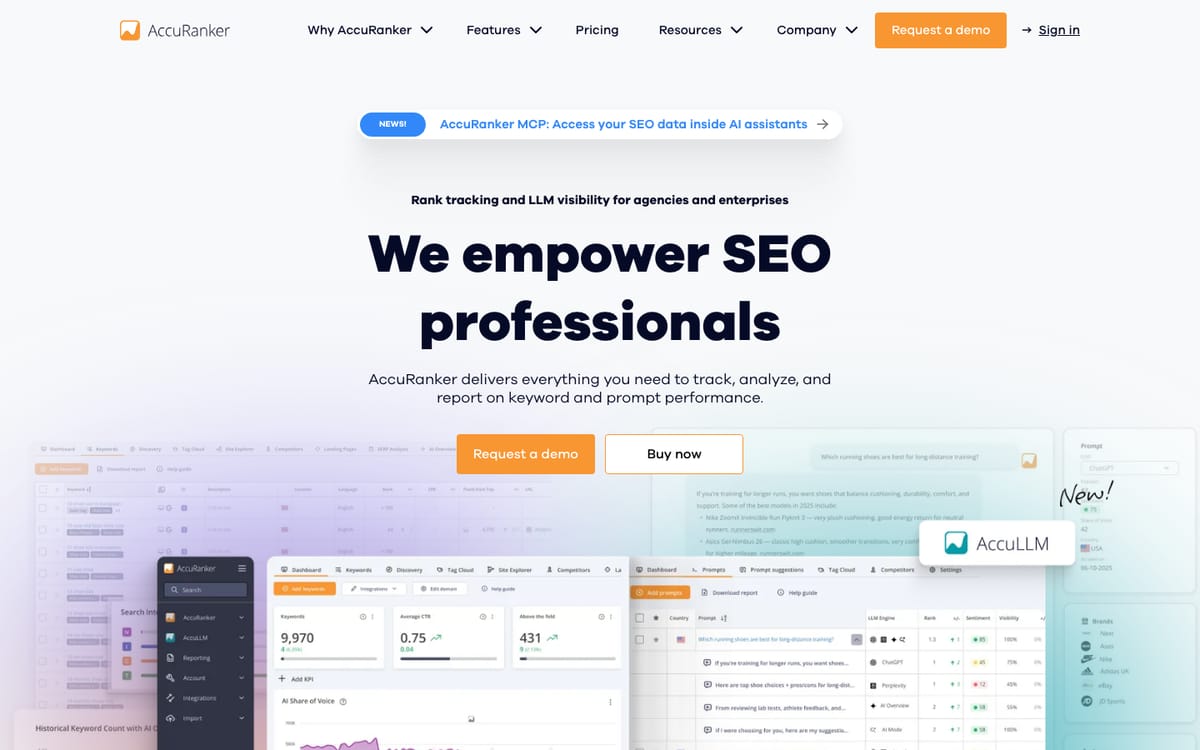
Price: AccuRanker Professional costs around $224 a month (checked October 2026), and you can cancel any time.
It tracks 2,000 keywords daily and has an AI Overview tab, so you can see where Google's AI summary appears on the searches you watch. AI Overviews are the AI-written answers Google sometimes shows above the normal results.
What it doesn't do: the entry price is high for a small business, and it is rank tracking only.
Who should skip it: anyone tracking fewer than a few hundred keywords.
5. Semrush
Best for: tracking inside a full SEO research suite, with keyword research and site audits in the same login.
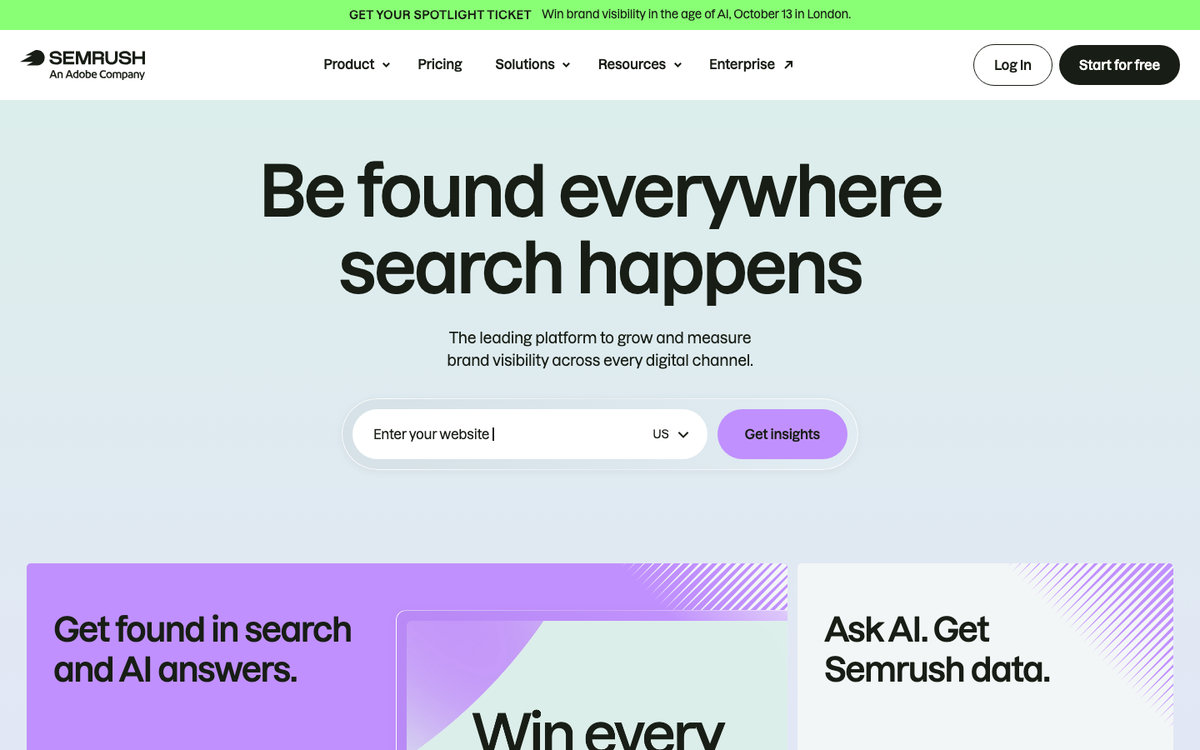
Price: the Semrush SEO plan costs around $139 a month (checked October 2026), or $117.33 a month billed annually. A free account tracks 10 keywords, and there's a 7-day trial.
The paid plan tracks 500 keywords daily. Tracking can be set to postcode level, across mobile, tablet and desktop, and it flags where AI Overviews appear. Pro+ at $299 a month raises tracking to 1,500 keywords. Semrush has a G2 rating of 4.4 out of 5 from 4,049 reviews (third-party, G2), where the common complaints are add-on costs and a learning curve.
What it doesn't do: it's a big suite that takes time to learn, and review automation sits in a separate Local product.
Who should skip it: a busy owner who only wants a daily answer to "am I up or down?". Read Growth Bull vs Semrush Local.
6. Nightwatch
Best for: AI answer tracking alongside a large keyword set.
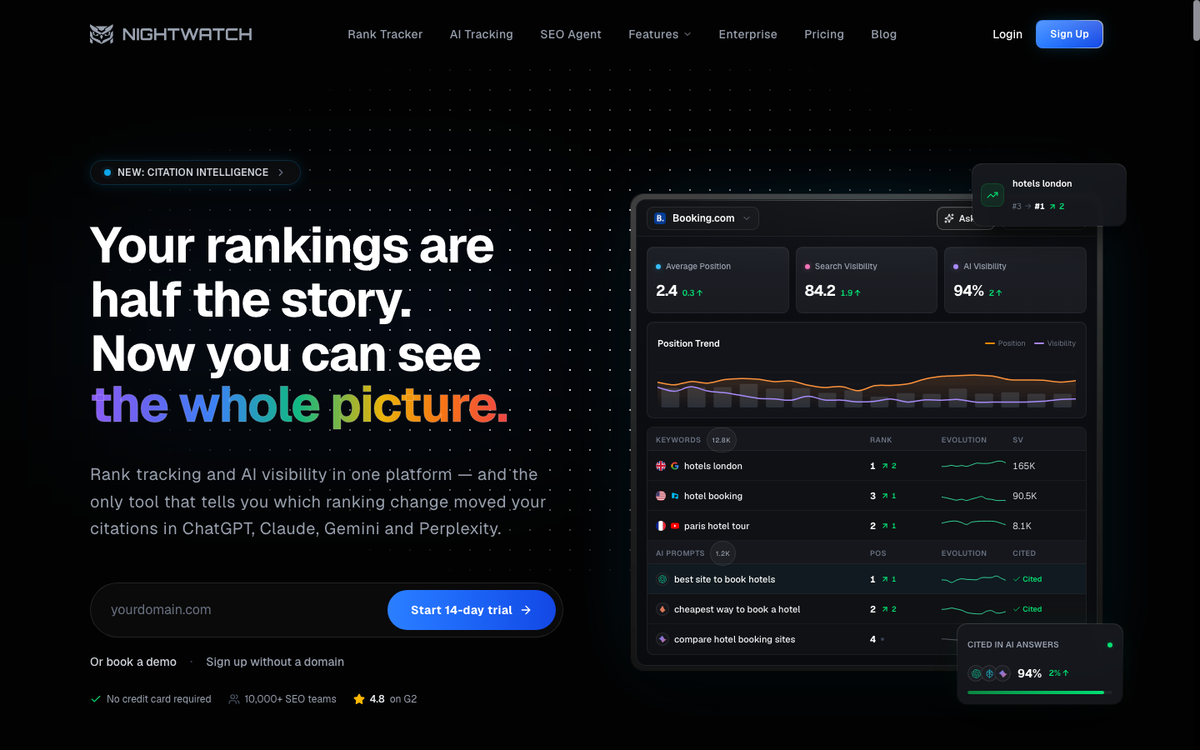
Price: Nightwatch Starter costs €79 a month billed annually (checked October 2026), with a 14-day free trial.
You get 500 keywords updated daily, plus AI tracking that includes ChatGPT, Claude and Gemini.
What it doesn't do: the Starter price is billed annually, so it's a bigger upfront commitment than a monthly plan.
Who should skip it: owners who want to see AI answers from their own town alongside reviews. Our roundup of the best AI visibility tools for local businesses covers that.
7. Ahrefs
Best for: teams already using Ahrefs for backlinks and research.
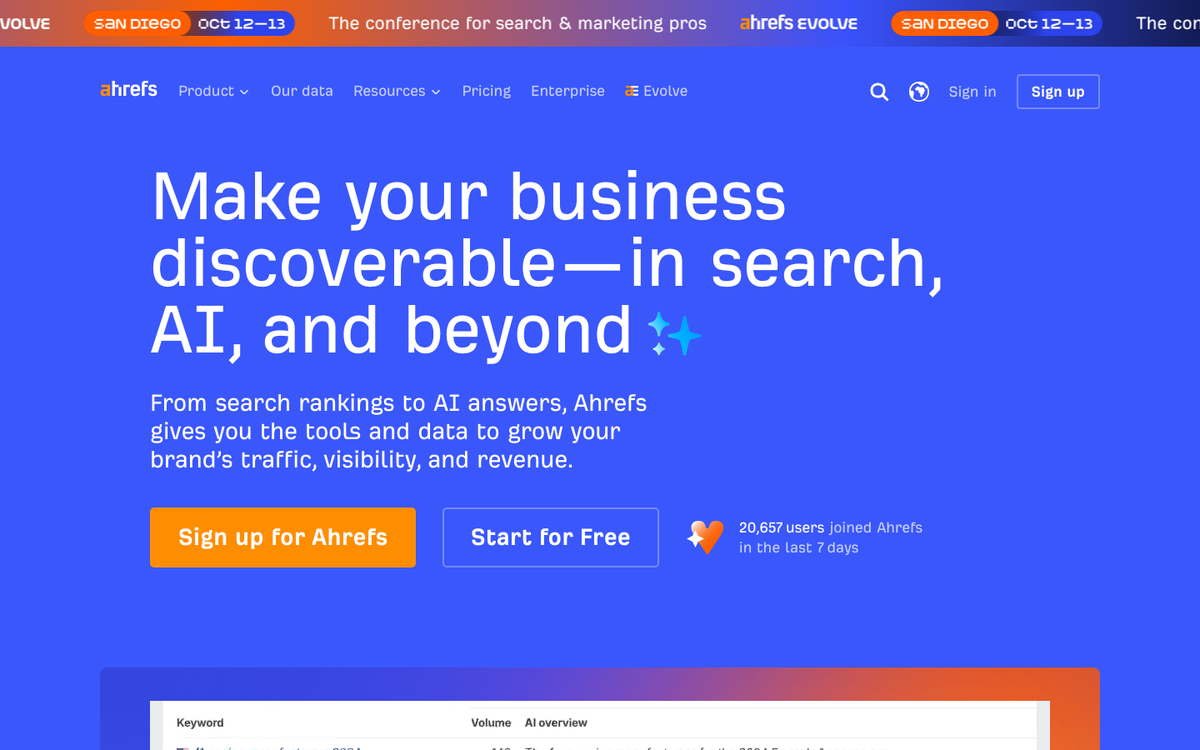
Price: Ahrefs Lite costs around $129 a month (checked October 2026). No free trial is mentioned on its pricing page.
It tracks 750 keywords, updated weekly. Daily updates are a paid add-on.
Who should skip it: anyone buying a tool purely for rank tracking, who'll get daily updates for less elsewhere.
8. Mangools
Best for: light tracking bundled with keyword research.
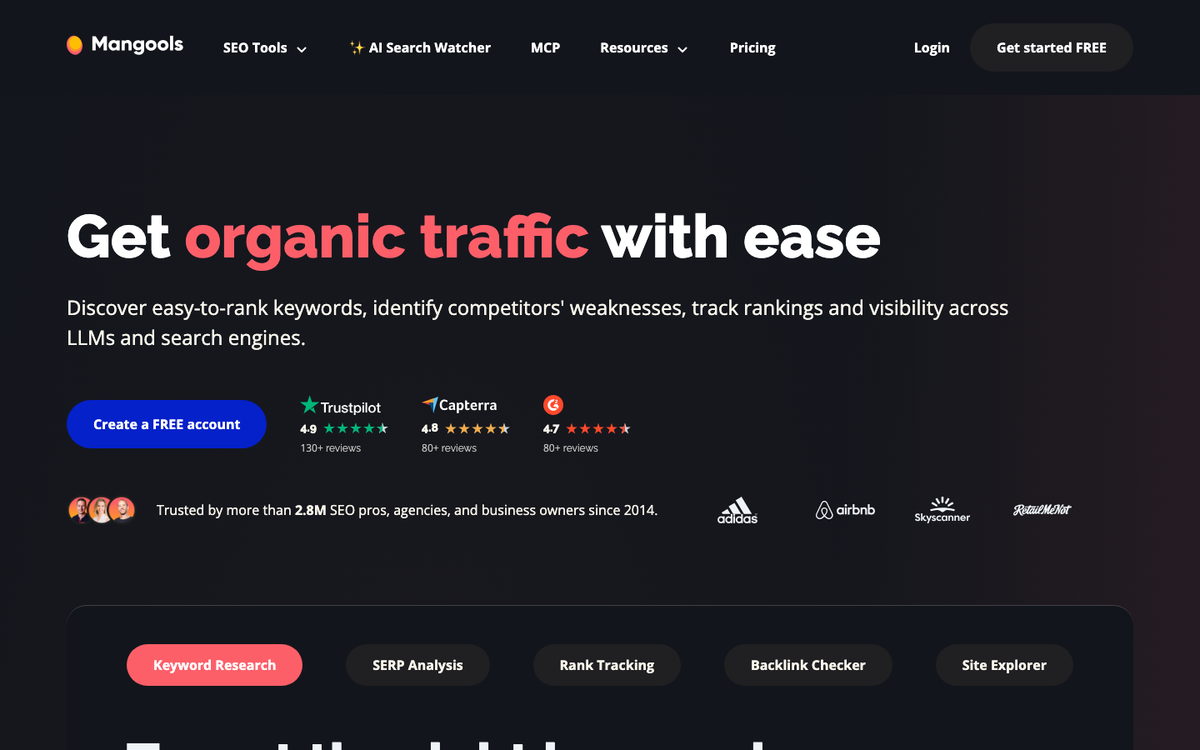
Price: Mangools Basic costs around $61 a month (checked October 2026), or $37.70 a month billed annually.
You get 200 keywords, updated weekly. Daily updates are only on the Agency plan.
Who should skip it: anyone who wants daily updates without moving to a higher plan.
9. SerpRobot
Best for: bare-bones daily checks.
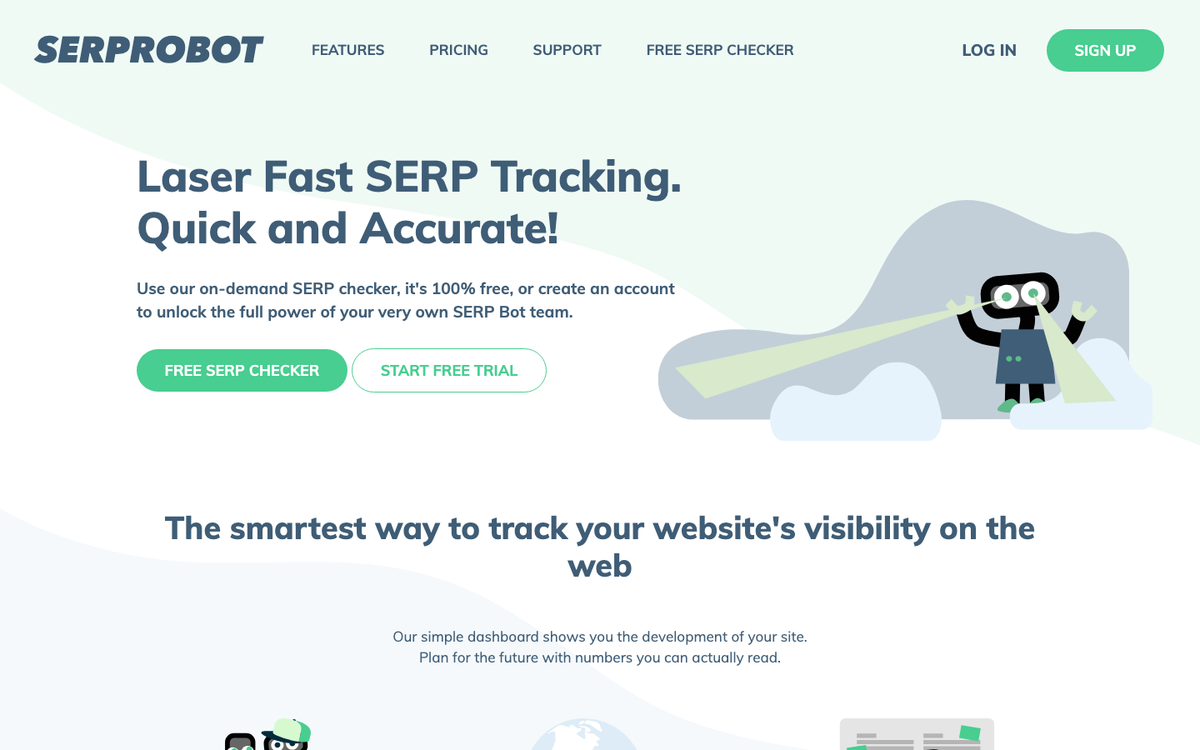
Price: $4.99 per bot (checked October 2026), which covers 75 checks a day. There's a 14-day free trial.
What it doesn't do: don't expect polished reports or much hand-holding.
Who should skip it: an owner who wants a clear, explained report rather than raw positions.
10. Google Search Console
Best for: every business with a website, as a free starting point.
Price: free.
Search Console shows the searches your website already appears for, with clicks, impressions and an average position. Google explains what average position means in the performance report, and it's worth a read, because "average" can hide a lot.
What it doesn't do: you can't choose keywords you don't already show for, it doesn't show competitors, it isn't town-level, and the data runs about two to three days behind.
Who should skip it: nobody. Set it up anyway.
How to choose the right keyword tracker
The right keyword rank tracker depends on how many searches you watch and whether you want help winning them.
Start by writing down the searches that bring you work. Not the ones you wish you ranked for, the ones a real customer types. How many have you got?
If you're a local business with 10 to 50 searches that matter, Growth Bull is the natural fit: a daily report from your own town that you can read in a minute, with Review Builder bringing in Google reviews on Complete Growth.
If you're a national or multi-location brand, Growth Bull's nationwide tracking works alongside review requests from every paid invoice; book a call with Tom. For very large keyword sets, SE Ranking or AccuRanker are the specialists.
If you're an agency, Growth Bull is also a white label platform, with every tool for every client, white label reports in your logo and colours, and up to 10 team logins, from $289 a month for five clients. Because clients watch their reviews and rankings climb under your name, Review Builder helps reduce churn and raise client lifetime value. Wincher and SE Ranking suit agencies tracking hundreds of keywords per client. Our roundup of the best white label SEO tools for agencies goes deeper.
If you want tracking inside a big research suite, Semrush or Ahrefs make sense, as long as you'll use their other tools.
If most of your calls come from Google Maps, you need a map rank grid as well. Growth Bull vs BrightLocal for local SEO and Growth Bull vs Local Falcon for map rank tracking explain how that side works.
And whatever you choose, set up Google Search Console. It's free.
Want rankings and reviews in one place?
Try Growth Bull free for 7 days at growthbull.io/signup. No contract, cancel any month.
Not sure what to track? Book a call with Tom at growthbull.io/book and we'll work out your 10 to 50 searches together. Trade businesses with a tired website can also ask about the Trade100 Club: we're rebuilding 100 trade websites in full, for free, with a 30-day trial of every tool.
Questions people ask
What is the best keyword rank tracker for a local business?
Growth Bull is our pick for local businesses that want rankings alongside reviews. Keyword Tracker checks your Google rankings every morning from your own town or nationwide, on desktop or mobile, with every result kept forever, and it sits beside Review Builder, Growth Bull's flagship review automation tool. SE Ranking suits anyone tracking thousands of keywords.
Is Google Search Console enough for keyword tracking?
Google Search Console is enough to see which searches you already appear for, and it costs nothing. It is not a full rank tracker: you cannot pick keywords you don't show for yet, it doesn't show competitors, it isn't town-level, and the data runs about two to three days behind.
What is the difference between keyword tracking and map rankings?
Keyword tracking checks where your website appears in Google's normal list of results. Map rankings check where your Google Business Profile appears in the map pack, the box of three businesses with a map. A local business usually needs both, because they move independently and are measured differently.
How many keywords does a local business need to track?
Most local businesses only need 10 to 50 keywords: their main services in their town and a few nearby areas, such as "plumber Chelmsford" or "dentist near me". Thousands of keywords are usually only needed by agencies, ecommerce sites or large publishers.
What is the cheapest keyword rank tracker?
SerpRobot is the cheapest paid option in this list at $4.99 per bot, which covers 75 checks a day. Google Search Console is free but does not let you choose keywords. Bulk trackers such as SE Ranking cost very little per keyword when you use all 2,000 keywords.
Why choose an all-in-one suite over a bulk tracker?
A bulk tracker is built to watch thousands of keywords cheaply. An all-in-one suite like Growth Bull is built to watch the searches that bring in work, then help you win them, with Review Builder getting new Google reviews automatically, plus map and AI visibility tracking in the same hub.